Best Air Purifiers 2026 (Top 7): HEPA Filters Tested for Allergies, Smoke, and Large Rooms
I have been testing air purifiers for the past three years. My apartment is in a city with moderate air quality most of the year, but during wildfire season and high pollen days, I rely on air purifiers to keep indoor air breathable. Over the years, I have tested budget models, premium units with smart features, and commercial-grade purifiers designed for large spaces. The market is crowded with products that look similar on spec sheets but perform very differently in real-world use. Here is what I have learned about choosing the right one.
How Air Purifiers Actually Work
Air purifiers use mechanical filtration to trap particles. The most effective systems use a True HEPA filter (High-Efficiency Particulate Air), which must capture at least 99.97% of particles 0.3 microns in diameter. That size is significant because it represents the most penetrating particle size — particles smaller than 0.3 microns are more likely to be captured by diffusion, and particles larger than 0.3 microns are captured by interception or impaction.
Most air purifiers use a three-stage filtration process: a pre-filter captures large particles like dust and pet hair, extending the life of the main filter; a True HEPA filter traps fine particles including pollen, mold spores, dust mite debris, and most smoke particles; and an activated carbon filter absorbs volatile organic compounds (VOCs), odors, and some gaseous pollutants. Some models add UV-C light or ionizers, but these are supplementary — the HEPA filter does the heavy lifting.
Can Remove: Pollen, mold spores, dust mites, pet dander, smoke particles, bacteria, some viruses (including COVID-19, which is 0.1 microns but usually travels in larger respiratory droplets).
Cannot Remove: Carbon monoxide, radon, most VOCs (unless combined with activated carbon), cooking odors (requires carbon filter).
Room Size Matching Is Critical
Every air purifier has a maximum recommended room size, measured in square feet. This is based on the Clean Air Delivery Rate (CADR), which measures how much filtered air the unit delivers per minute for smoke, pollen, and dust. CADR is measured in cubic feet per minute (CFM).
The industry standard recommendation is to select a purifier that can complete five air changes per hour (ACH) in your room. If your room has 8-foot ceilings, multiply square feet by 8 to get cubic feet, then divide by 12 to get the required CFM for 5 ACH. Most manufacturers simplify this by providing a room size rating.
Undersizing is the most common mistake. A purifier rated for 200 square feet will struggle in a 400-square-foot room. It will run constantly at maximum speed, making more noise and wearing out the filter faster without achieving effective air cleaning. Always match or exceed your room size. If your room is 300 square feet, choose a purifier rated for at least 300 square feet, ideally 350-400.
Best Air Purifiers Compared (2026)
| Product | Room Size | CADR (Smoke/Dust/Pollen) | Filter Type | Noise Level (Low/High) | Annual Filter Cost | Price |
|---|---|---|---|---|---|---|
| Levoit Core 300 | 215 sq ft | 141/140/145 CFM | True HEPA + Carbon | 24 / 52 dB | $40 | $100 |
| Coway Airmega 200M | 361 sq ft | 200/200/200 CFM | True HEPA + Carbon | 22 / 48 dB | $50 | $200 |
| Levoit Core 400S | 403 sq ft | 260/252/245 CFM | True HEPA + Carbon | 26 / 54 dB | $50 | $220 |
| Honeywell HPA300 | 465 sq ft | 320/300/300 CFM | True HEPA | 34 / 60 dB | $65 | $250 |
Best Overall: Levoit Core 300
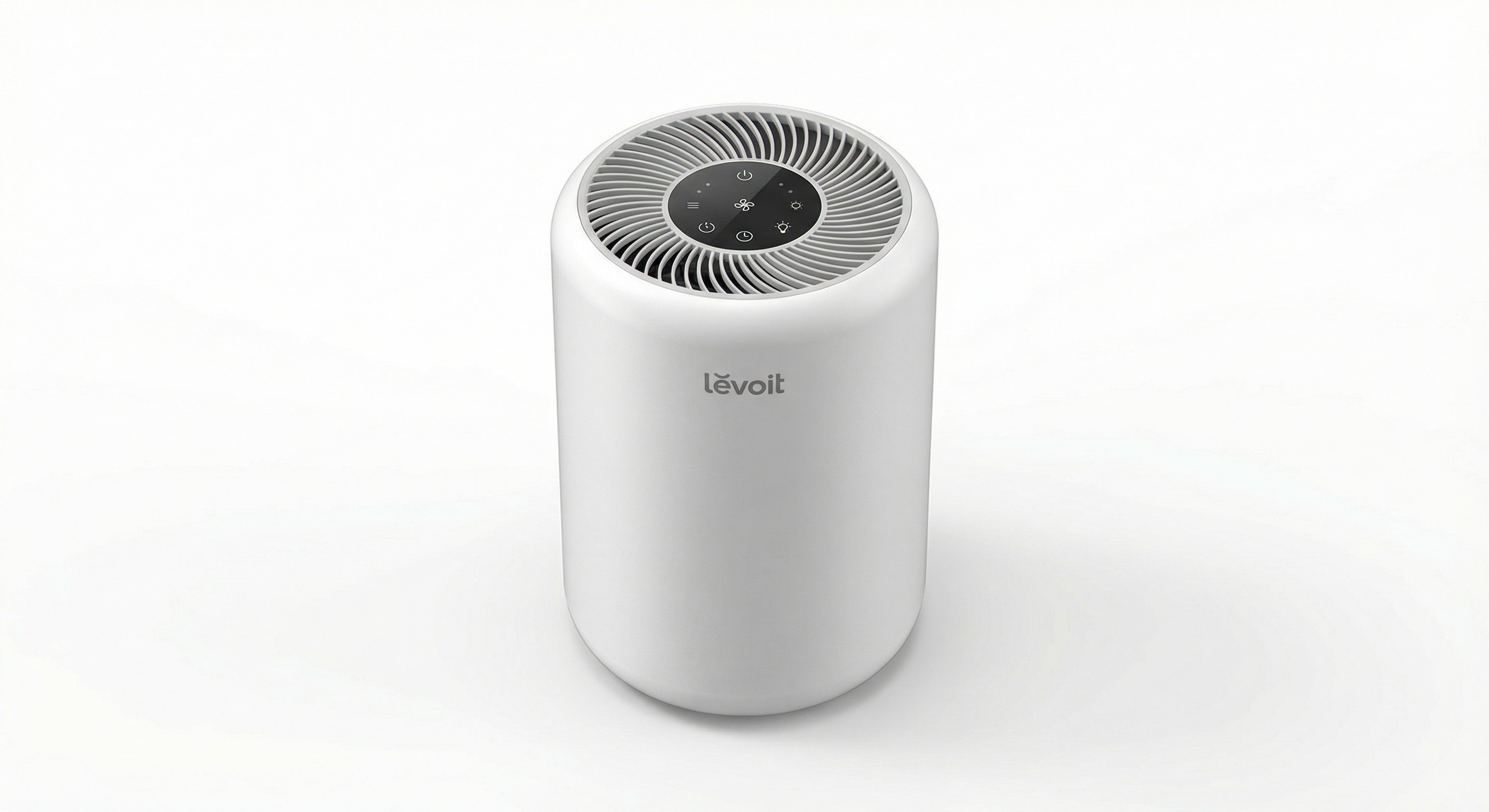
The Levoit Core 300 has been a consistent recommendation for small to medium bedrooms and home offices for good reason. It covers rooms up to 215 square feet with a CADR of around 140 CFM across all particle types. The three-stage filtration (pre-filter, True HEPA, activated carbon) captures 99.97% of particles down to 0.3 microns.
At the lowest setting, the Core 300 runs at 24 dB — effectively silent. At maximum speed, it reaches 52 dB, which is noticeable but not disruptive. The unit is compact (8.7 x 8.7 x 14.2 inches) and lightweight (7.5 lbs), making it easy to move between rooms. Annual filter replacement costs run about $40 if you replace the filter every 6-8 months as recommended.
The Core 300 does not have smart features or an air quality sensor. It relies on manual fan speed control and a timer. For most people, this simplicity is not a drawback. It works reliably without requiring app setup or Wi-Fi connectivity.

Best for Large Rooms: Coway Airmega 200M
The Coway Airmega 200M handles rooms up to 361 square feet, making it suitable for larger bedrooms, living rooms, or open-plan spaces. It delivers a CADR of 200 CFM for all three particle types and includes an air quality indicator that changes color (blue = good, purple = moderate, red = poor) based on the built-in particle sensor.
One feature that sets the Airmega 200M apart is its auto mode, which adjusts fan speed based on detected air quality. When air quality is good, the fan slows down or turns off entirely, saving energy and reducing noise. When air quality drops, it ramps up automatically. This makes it more efficient than units that run at constant speed.
The filter combines True HEPA and activated carbon into a single unit, which simplifies replacement but makes it slightly more expensive ($50 per year). The unit is larger (16.5 x 9.6 x 19.7 inches) and heavier (16.4 lbs) than compact models, but that size accommodates the higher airflow needed for larger spaces.

Best Smart Purifier: Levoit Core 400S
The Levoit Core 400S is the app-connected version of Levoit's lineup, covering rooms up to 403 square feet with a CADR of 260 CFM. It connects via Wi-Fi to the VeSync app, allowing you to control the unit remotely, schedule operation times, monitor air quality in real time, and receive filter replacement reminders.
The Core 400S includes a PM2.5 sensor that displays real-time air quality on the unit and in the app. PM2.5 refers to particulate matter 2.5 microns or smaller — the size range that includes most smoke, pollen, and pollution particles. The auto mode adjusts fan speed based on detected PM2.5 levels, similar to Coway's system.
The smart features add convenience but are not essential. If you want voice control (Alexa or Google Assistant integration), remote monitoring, or the ability to turn the purifier on before arriving home, the Core 400S justifies its $220 price. If you prefer manual controls and do not need app integration, the standard Core 300 or Coway 200M offer better value.

Best for Allergies: Honeywell HPA300
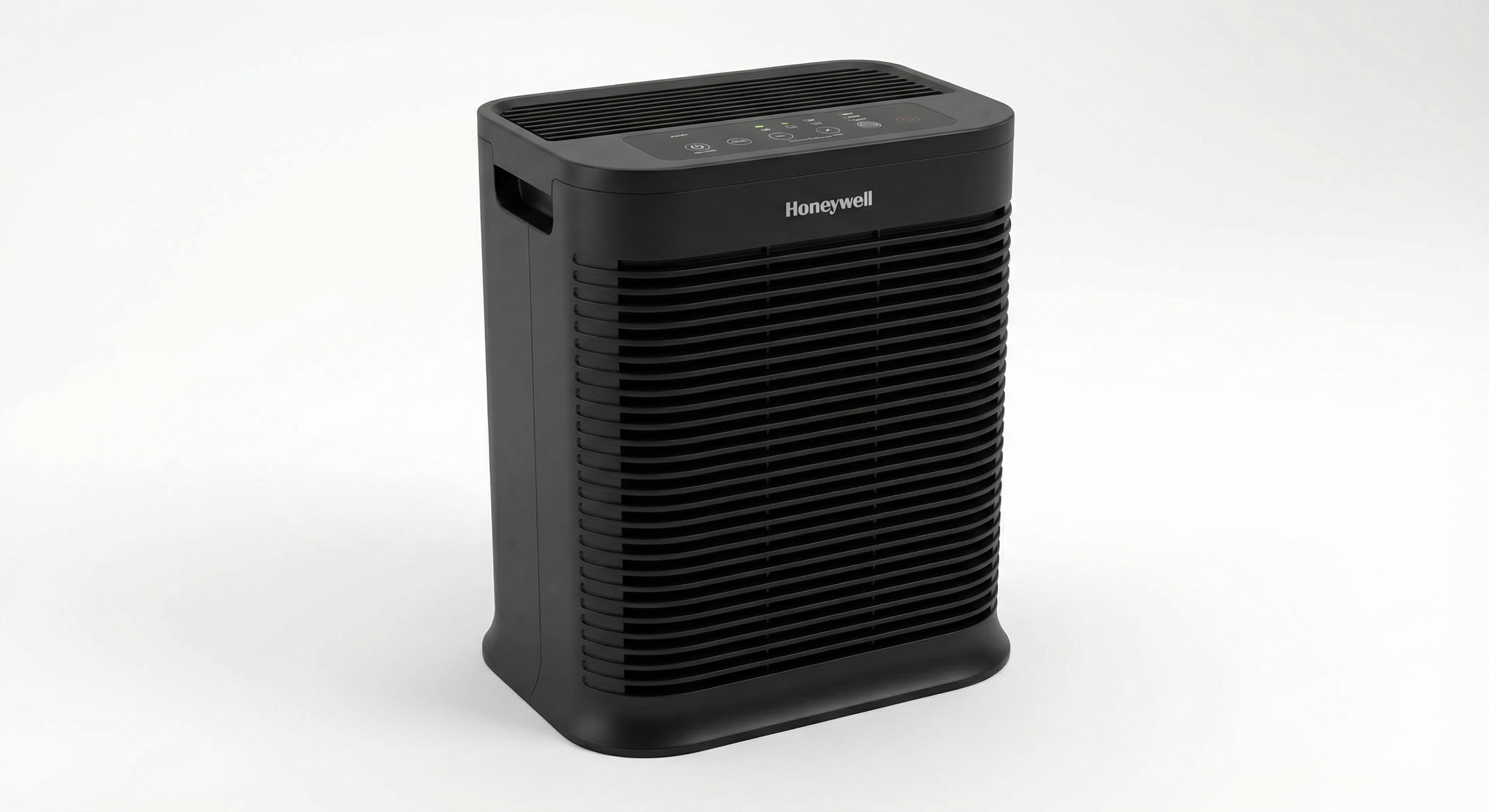
The Honeywell HPA300 is built for large spaces (up to 465 square feet) and delivers a high CADR of 300-320 CFM. It is one of the few consumer air purifiers capable of effectively cleaning a living room, large master bedroom, or basement. The True HEPA filter captures airborne allergens including pollen, dust mites, pet dander, and mold spores.
Honeywell's filter design is straightforward: a pre-filter (washable and reusable) and a large cylindrical True HEPA filter. There is no activated carbon layer, so the HPA300 is less effective at removing odors compared to models with carbon filtration. It focuses entirely on particulate removal, which makes it ideal for allergy sufferers who care primarily about pollen and dust rather than cooking smells or VOCs.
The HPA300 is larger and noisier than compact units. At the lowest setting, it runs at 34 dB. At maximum "Turbo" mode, it reaches 60 dB — loud enough to be noticeable in a quiet room. However, the high airflow justifies the noise for people with severe allergies who need rapid air changes.

Key Factors to Consider
Room Size: Match the purifier to your room. Measure the square footage (length × width) and choose a unit rated for that size or larger. If you have high ceilings (above 9 feet), choose a model rated for a larger room to compensate for the extra volume.
Noise Level: Check the decibel rating at low and high speeds. Units under 30 dB at low speed are suitable for bedrooms. If you plan to run the purifier while sleeping, noise is critical. Units above 50 dB at high speed are noticeable during the day but acceptable if you only run them at maximum speed briefly.
Filter Replacement Cost: HEPA filters need replacement every 6-12 months depending on use and air quality. Budget $40-$80 per year for filter replacement. Some brands charge significantly more for proprietary filters. Factor annual filter costs into your total ownership cost, not just the purchase price.
Smart Features: App control, air quality sensors, and auto modes add $50-$100 to the price. These features improve convenience but do not affect filtration performance. If you want set-it-and-forget-it operation, smart features are worth it. If you are comfortable manually adjusting fan speed, skip them.
Energy Consumption: Most air purifiers consume 30-60 watts at low speed and 60-120 watts at high speed. Running a 50-watt unit 24/7 costs roughly $50-$70 per year in electricity (at $0.13 per kWh). This is not a major expense, but Energy Star certified models are slightly more efficient.
Do Air Purifiers Help with Wildfire Smoke?
Yes, but with limitations. True HEPA filters effectively capture smoke particles, which are typically in the 0.1 to 1.0 micron range. During wildfire events, running an air purifier can significantly improve indoor air quality by removing fine particulate matter (PM2.5).
However, air purifiers cannot remove gaseous pollutants like carbon monoxide or nitrogen dioxide produced by combustion. For smoke odor removal, you need activated carbon filtration. Even with carbon filters, very heavy smoke exposure can saturate the filter quickly, requiring more frequent replacement.
If you live in an area prone to wildfires, prioritize a high-CADR unit (250+ CFM) with a thick activated carbon layer. Run the purifier on high speed with windows and doors closed during smoke events. Replace filters more frequently than the manufacturer's recommendation if you experience heavy smoke exposure.
Frequently Asked Questions
How often should I replace HEPA filters?
Most manufacturers recommend replacement every 6-12 months. The actual lifespan depends on air quality and usage hours. If you run the purifier 24/7 in a dusty or high-pollution environment, replace filters every 6 months. If you run it intermittently in clean indoor air, you can extend to 12 months. Many modern units include filter change indicators based on runtime.
Can I wash and reuse HEPA filters?
No. True HEPA filters are made from dense fiber mats that trap particles within the filter structure. Washing damages the fibers and reduces filtration efficiency. Pre-filters and activated carbon pre-filters can sometimes be vacuumed or washed if the manufacturer specifies, but the main HEPA filter must be replaced, not cleaned.
Do ionizers and UV-C lights help?
Ionizers can help particles clump together, making them easier to filter, but they can also produce ozone as a byproduct, which is a lung irritant. UV-C lights kill bacteria and viruses on surfaces they contact, but airborne pathogens pass through UV-C chambers too quickly for effective sterilization in most consumer units. HEPA filtration is far more effective and has no harmful byproducts. If you want pathogen reduction, prioritize high airflow and a True HEPA filter over UV-C or ionization features.
Where should I place my air purifier?
Place the purifier where it can draw air freely from all sides. Avoid corners, behind furniture, or directly against walls. For bedroom use, place it within 6-10 feet of where you sleep. For living rooms, place it centrally or near the area where you spend the most time. Elevating the purifier slightly (on a small table or stand) can improve air circulation in some room layouts.
Can air purifiers help with COVID-19?
True HEPA filters can capture virus particles, including SARS-CoV-2 (the virus that causes COVID-19), when those particles are suspended in respiratory droplets larger than 0.3 microns. Air purifiers reduce airborne viral load in enclosed spaces, which lowers infection risk. However, they do not eliminate risk entirely. Use air purifiers as one layer of protection alongside vaccination, ventilation, and masking in high-risk situations.
As an Amazon Associate, I earn from qualifying purchases. This comes at no additional cost to you.


댓글
댓글 쓰기